The Jharkhand Calendar 2026 reflects all of this. It is not just a list of dates. It is a year-long portrait of the state’s identity. The Jharkhand Govt Calendar 2026 officially recognises 21 Gazetted Holidays and 13 additional holidays under Executive Order — a total of 34 official non-working days spread across the year. What makes this calendar stand apart from those of other states is its formal inclusion of tribal festivals as gazetted public holidays. Sarhul, Sohrai, Karma Puja, and Hul Diwas are not mere cultural footnotes — they are official, mandatory holidays, acknowledged by the state government as integral to Jharkhand’s heritage and the rights of its indigenous communities.
This complete guide to the Jharkhand Calendar 2026 covers every holiday, festival, bank closure, and special occasion month by month, with clear tables and detailed explanations — everything you need to plan your entire year with confidence.
Jharkhand Govt Calendar 2026 – Key Statistics
| Detail | Information |
|---|---|
| State | Jharkhand |
| Calendar Year | 2026 |
| Total Gazetted Holidays | 21 |
| Executive Order Holidays | 13 |
| National Holidays | 3 (Republic Day, Independence Day, Gandhi Jayanti) |
| Tribal / Indigenous Festivals | 7 (Sohrai, Sarhul, Karma Puja x2, Hul Diwas, Birsa Munda Jayanti, Jharkhand Foundation Day) |
| Major Religious Holidays | 15+ (Hindu, Muslim, Sikh, Christian, Buddhist, Jain) |
| Bank Holiday Saturdays | 2nd and 4th of every month |
| Annual Bank Closing Day | April 1, 2026 |
| Official Language of Calendar | Hindi and English |
Download the Jharkhand Calendar 2026 PDF
For offline access, you can download the complete Jharkhand Calendar 2026 in PDF format. It’s a handy, printable version you can pin on your wall, put up on an office notice board, or save on your phone for quick reference anytime.
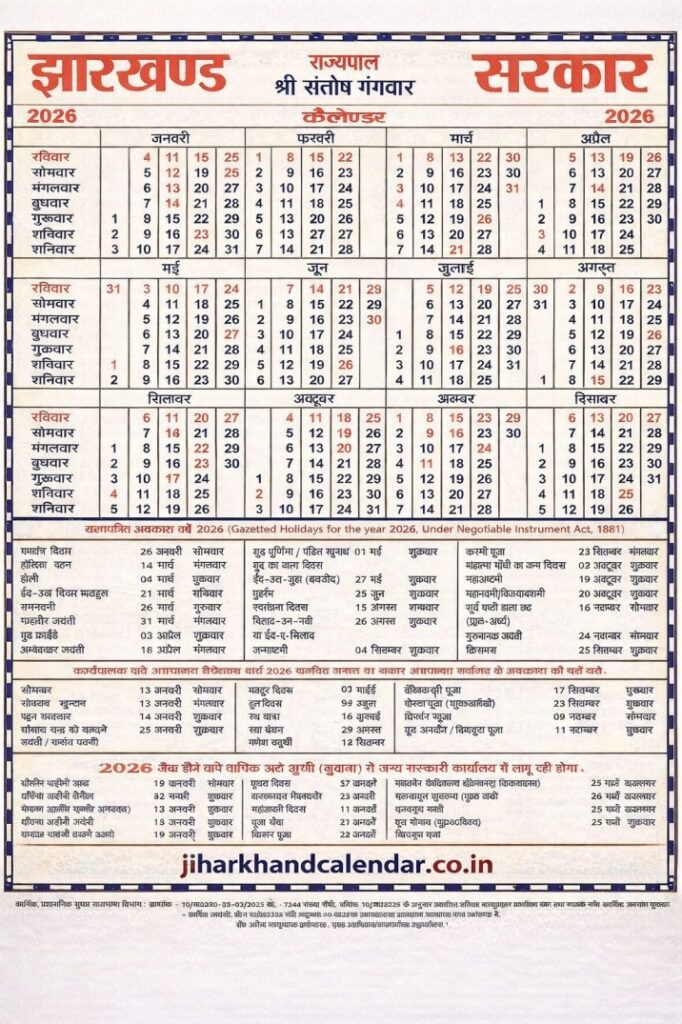
Jharkhand Calendar 2026 – Full Year Holiday Table
| Sr. No. | Month | Major Festivals / Holidays (2026) |
|---|---|---|
| 1 | January | Sohrai, Sohrai Khuntaw, Makar Sankranti, Netaji Jayanti/Basant Panchami, Republic Day |
| 2 | February | Sant Ravidas Jayanti, Magha Purnima, Mahashivratri |
| 3 | March | Holika Dahan, Holi, Sarhul/Eid-ul-Fitr, Ram Navami, Mahavir Jayanti |
| 4 | April | Bank Annual Closing Day, Good Friday, Ambedkar Jayanti, Akshaya Tritiya |
| 5 | May | Buddha Purnima/Raghunath Murmu Jayanti/Labour Day, Eid-ul-Zuha (Bakrid) |
| 6 | June | Muharram, Hul Diwas, International Yoga Day |
| 7 | July | Rath Yatra, Guru Purnima, Devshayani Ekadashi (Chaturmas begins) |
| 8 | August | Independence Day, World Tribal Day, Raksha Bandhan, Milad-un-Nabi |
| 9 | September | Janmashtami, Ganesh Chaturthi, Vishwakarma Puja, Karma Puja |
| 10 | October | Gandhi Jayanti, Navratri, Dussehra, Karwa Chauth, Sardar Patel Jayanti |
| 11 | November | Diwali, Chhath Puja, Jharkhand Foundation Day/Birsa Munda Jayanti, Guru Nanak Jayanti |
| 12 | December | Gita Jayanti, Christmas, New Year’s Eve |
Month-Wise Holiday Count – Jharkhand 2026
| Month | Number of Holidays | Key Occasions |
|---|---|---|
| January | 5 | Sohrai (x2), Makar Sankranti, Bose Jayanti, Republic Day |
| February | 0 | No gazetted holidays |
| March | 4 | Holika Dahan, Holi, Sarhul/Eid-ul-Fitr, Ram Navami |
| April | 4 | Mahavir Jayanti, Bank Closing, Good Friday, Ambedkar Jayanti |
| May | 2 | Buddha Purnima/Labour Day, Bakrid |
| June | 2 | Muharram, Hul Diwas |
| July | 1 | Rath Yatra |
| August | 3 | Independence Day, Milad-un-Nabi, Raksha Bandhan |
| September | 4 | Janmashtami, Ganesh Chaturthi, Vishwakarma Puja, Karma Puja (x2) |
| October | 3 | Gandhi Jayanti, Maha Ashtami, Dussehra |
| November | 6 | Govardhan Puja, Bhai Dooj, Foundation Day, Chhath Puja, Guru Nanak Jayanti |
| December | 1 | Christmas |
Note: February 2026 has no gazetted holidays. November is the richest month with 6 holidays. January is second with 5 holidays.
National Holidays in Jharkhand 2026
| Date | Day | Holiday | Significance |
|---|---|---|---|
| 26 January | Monday | Republic Day | India’s Constitution came into force (1950) |
| 15 August | Saturday | Independence Day | India’s freedom from British rule (1947) |
| 2 October | Friday | Gandhi Jayanti | Birth anniversary of Mahatma Gandhi (1869) |
These three national holidays are mandatory across all states and union territories. All government offices, banks, schools, and courts in Jharkhand remain closed on these days regardless of any other calendar variation.
Jharkhand’s Tribal Festivals 2026
The single most distinctive feature of the Jharkhand Govt Calendar 2026 is its official recognition of indigenous tribal festivals as gazetted public holidays. No other state calendar in India integrates tribal heritage so comprehensively into its official structure. Here is a detailed look at each tribal occasion:
Sohrai – 12 and 13 January 2026
Sohrai is the premier harvest and cattle-worship festival of Jharkhand’s indigenous communities — the Santhal, Munda, and Ho peoples — celebrated each year after the kharif harvest. It marks the community’s gratitude to nature, livestock, and the agricultural cycle that sustains life on the Chota Nagpur Plateau.
During Sohrai, homes are adorned with intricate mud paintings and floral patterns called Sohrai art — a centuries-old tradition now internationally recognised. Cattle are bathed, garlanded, and honoured with community prayers. The two-day structure — Sohrai on January 12 and Sohrai Khuntaw on January 13 — creates a complete ceremonial arc of gratitude and celebration.
| Sohrai Key Facts | Details |
|---|---|
| Dates in 2026 | 12 January (Mon) and 13 January (Tue) |
| Communities | Santhal, Munda, Ho, Oraon |
| Theme | Post-harvest gratitude, cattle worship |
| Distinctive Feature | Sohrai mud art paintings on home walls |
| Holiday Status | Gazetted Holiday (both days) |
Sarhul – 21 March 2026
Sarhul is arguably the most spiritually powerful festival in all of Jharkhand — a celebration of the new year and the arrival of spring, centred on the sacred Sal tree (Shorea robusta). The Sal flower, which blooms in March, is the focal offering of this festival and is used in rituals conducted by the village priest (Pahan) at the Sarna sacred grove.
The festival involves prayers for the community’s wellbeing, prosperity, and harmony with nature. Processions, traditional dance, and communal meals bring villages together on this day. In 2026, Sarhul coincides with Eid-ul-Fitr — a remarkable convergence of tribal and Islamic celebrations that reflects Jharkhand’s communal coexistence.
| Sarhul Key Facts | Details |
|---|---|
| Date in 2026 | Saturday, 21 March |
| Sacred Element | Sal tree (Shorea robusta) and Sal flowers |
| Ritual Leader | Village priest (Pahan) at Sarna sacred grove |
| Coincides With | Eid-ul-Fitr in 2026 |
| Communities | Munda, Ho, Santhal, Oraon, Kharia |
| Holiday Status | Gazetted Holiday |
Karma Puja – 22 and 23 September 2026
Karma Puja celebrates two things simultaneously — the sacred sibling bond between brothers and sisters, and the worship of the Karma tree, which represents strength, good fortune, and long life. Young women observe a day-long fast, perform rituals around the Karma tree, and sing traditional karma songs seeking blessings for their brothers’ health and prosperity.
The two-day structure — Karma Puja on September 22 and Karma Puja Phulkhansi on September 23 — allows for the full ceremonial cycle to be completed. This festival is particularly significant in the tribal calendar as it weaves together nature worship and family devotion in one seamless observance.
| Karma Puja Key Facts | Details |
|---|---|
| Dates in 2026 | 22 September (Tue) and 23 September (Wed) |
| Sacred Tree | Karma tree |
| Observed Mainly By | Women — praying for brothers’ welfare |
| Ritual | Fasting, karma songs, tree worship |
| Holiday Status | Gazetted Holiday (both days) |
Hul Diwas – 30 June 2026
Hul Diwas is one of the most historically charged days in the Jharkhand Calendar 2026. The word Hul means revolution in the Santhal language, and this day commemorates the great Santhal Rebellion of 1855 — a watershed uprising in Indian colonial history.
Led by the Santhal brothers Sidho Murmu and Kanho Murmu, the Hul was a mass resistance against the double oppression of British colonial authority and the exploitative zamindari system that had stripped tribal communities of their land and dignity. On June 30, 1855, thousands of Santhal men and women took up arms and marched — a movement that shook the colonial administration and foreshadowed the 1857 uprising by nearly two years.
Hul Diwas is observed across Jharkhand with official rallies, memorials at the Bhognadih village (birthplace of Sidho-Kanho), and tributes at government institutions. It is a gazetted holiday — a state-level declaration that the revolution of 1855 belongs to the founding story of this land.
| Hul Diwas Key Facts | Details |
|---|---|
| Date in 2026 | Tuesday, 30 June |
| Event Commemorated | Santhal Rebellion of 1855 |
| Leaders | Sidho Murmu and Kanho Murmu |
| Hul Meaning | Revolution (in Santhal language) |
| Significance | One of India’s earliest organised anti-colonial uprisings |
| Holiday Status | Gazetted Holiday |
Jharkhand Foundation Day and Birsa Munda Jayanti – 15 November 2026
November 15 is the most emotionally significant date in the entire Jharkhand Govt Calendar 2026. It carries two powerful commemorations on a single day.
Jharkhand Foundation Day marks the birth of Jharkhand as a separate state on November 15, 2000 — when it was carved out of Bihar after decades of sustained tribal movement demanding a homeland of their own. The formation of Jharkhand was the culmination of aspirations held by millions of indigenous people across the Chota Nagpur Plateau and the Santhal Parganas.
Birsa Munda Jayanti celebrates the birth anniversary of Bhagwan Birsa Munda, born on November 15, 1875 — the revered tribal freedom fighter, healer, and revolutionary whom the people call Dharti Aba (Father of the Earth). Birsa Munda led the Ulgulan (Great Tumult) against British rule and the zamindari system in the late 19th century. His portrait now hangs in the Central Hall of India’s Parliament — one of very few non-politician, non-freedom-movement figures to receive this honour.
| November 15 Key Facts | Details |
|---|---|
| Date in 2026 | Sunday, 15 November |
| Event 1 | Jharkhand Foundation Day — state formed on 15 Nov 2000 |
| Event 2 | Birsa Munda Jayanti — born 15 Nov 1875 |
| Birsa Munda Title | Dharti Aba (Father of the Earth) |
| His Movement | Ulgulan (Great Tumult) against British and zamindars |
| His Image | In the Central Hall of India’s Parliament |
| Holiday Status | Gazetted Holiday |
| Note | Falls on Sunday in 2026 |
Special Days – Pt. Raghunath Murmu Jayanti (1 May 2026)
May 1, 2026 carries three observances: Labour Day, Buddha Purnima, and the birth anniversary of Pandit Raghunath Murmu — the visionary Santali scholar who created the Ol Chiki script, a writing system designed specifically for the Santali language.
Before Ol Chiki, Santali was written using borrowed scripts like Devanagari, Bengali, or Roman. Pt. Murmu’s invention gave Santali an identity of its own — one of the few indigenous tribal languages in the world to have a script created by a member of its own community. Ol Chiki is now officially recognised in India’s Constitution (Eighth Schedule) and is taught in Jharkhand’s schools.
| Pt. Raghunath Murmu Jayanti Facts | Details |
|---|---|
| Date in 2026 | Friday, 1 May |
| Known For | Created Ol Chiki script for Santali language |
| Script Recognition | 8th Schedule of Indian Constitution |
| Also Observed On | Labour Day, Buddha Purnima |
| Holiday Status | Gazetted Holiday |
Bank Holidays in Jharkhand 2026
| Date | Day | Reason | Bank Status |
|---|---|---|---|
| 26 January | Monday | Republic Day | Closed |
| 4 March | Wednesday | Holi | Closed |
| 21 March | Saturday | Sarhul / Eid-ul-Fitr | Closed |
| 1 April | Wednesday | Annual Bank Account Closing Day | Closed |
| 1 May | Friday | Labour Day / Buddha Purnima | Closed |
| 27 May | Wednesday | Eid-ul-Adha (Bakrid) | Closed |
| 15 August | Saturday | Independence Day | Closed |
| 2 October | Friday | Gandhi Jayanti | Closed |
| 8 November | Sunday | Diwali (Deepawali) | Closed |
| 25 December | Friday | Christmas | Closed |
Additional Closures Every Month:
- 2nd Saturday: Banks closed (RBI rule)
- 4th Saturday: Banks closed (RBI rule)
- All Sundays: Weekly off
Important Note: April 1 is the Annual Bank Closing Day — a nationwide banking-sector holiday marking the end of the financial year. All major inter-bank settlements and financial clearances should be planned for March 31 or April 2. This holiday does not affect government offices — only banks.
Holiday Types in the Jharkhand Govt Calendar 2026
| Holiday Type | Meaning | Who It Affects | Mandatory |
|---|---|---|---|
| Gazetted Holiday (GH) | Officially declared by state government | All govt offices, schools, banks | Yes |
| Executive Order Holiday | Granted through specific govt notification | All govt offices and institutions | Yes |
| Restricted Holiday (RH) | Optional holidays — employees choose from approved list | Eligible govt employees | No (optional) |
| NI Act Holiday | Under Negotiable Instruments Act | Banks and financial institutions | Yes (for banks) |
| 2nd and 4th Saturday | RBI mandate — banks only | Banks only | Yes (for banks) |
| Annual Bank Closing (April 1) | End of financial year closing | Banks only | Yes (for banks) |
Frequently Asked Questions
Q1. How many gazetted holidays are there in Jharkhand in 2026?
The Jharkhand government has declared 21 Gazetted Holidays and 13 additional holidays under Executive Order for 2026. Together these form a comprehensive official holiday schedule covering national, religious, and tribal observances across the state.
Q2. When is Sarhul in the Jharkhand Calendar 2026?
Sarhul 2026 falls on Saturday, 21 March. In a remarkable coincidence, it falls on the same day as Eid-ul-Fitr in 2026, making March 21 a shared celebration across tribal and Muslim communities in Jharkhand.
Q3. When is Karma Puja in Jharkhand 2026?
Karma Puja 2026 is observed across two consecutive days — Tuesday, 22 September (Karma Puja) and Wednesday, 23 September (Karma Puja Phulkhansi). Both are official gazetted holidays in the Jharkhand government calendar.
Q4. When is Hul Diwas in 2026?
Hul Diwas falls on Tuesday, 30 June 2026. It commemorates the Santhal Rebellion of 1855 led by the Santhal brothers Sidho and Kanho Murmu against British colonial rule. It is a gazetted public holiday in Jharkhand.
Q5. When is Jharkhand Foundation Day in 2026?
Jharkhand Foundation Day falls on Sunday, 15 November 2026. This marks the day Jharkhand was carved out of Bihar in 2000. The same date also marks Birsa Munda Jayanti. Since it falls on a Sunday in 2026, no separate compensatory holiday is typically granted under standard government calendar policy.
Q6. When is Chhath Puja in Jharkhand 2026?
Chhath Puja (Surya Shashthi — the morning Arghya, which is the main day) falls on Monday, 16 November 2026. It is a major gazetted holiday in Jharkhand, observed with great devotion at rivers and water bodies across the state.
Q7. Is April 1 a bank holiday in Jharkhand in 2026?
Yes. April 1, 2026 is the Annual Bank Account Closing Day — a mandatory banking holiday across all scheduled banks in India, marking the end of the financial year. All bank branches remain closed. Government offices are not affected and remain open.
Q8. What are Jharkhand’s unique tribal holidays in 2026?
Jharkhand officially recognises Sohrai (12–13 January), Sarhul (21 March), Karma Puja (22–23 September), Hul Diwas (30 June), Jharkhand Foundation Day and Birsa Munda Jayanti (15 November), and Chhath Puja (16 November) as gazetted holidays rooted in the state’s indigenous heritage.
Q9. Which month has the most holidays in Jharkhand in 2026?
November 2026 has the most gazetted holidays — 6 occasions including Govardhan Puja, Bhai Dooj, Jharkhand Foundation Day, Birsa Munda Jayanti, Chhath Puja, and Guru Nanak Jayanti. January comes second with 5 holidays.
Q10. Why does the Jharkhand calendar include tribal festivals as official holidays?
The Jharkhand state government officially includes tribal festivals as gazetted holidays in recognition of the state’s indigenous identity. Jharkhand was formed precisely to give its tribal communities — Santhal, Munda, Ho, Oraon, Kharia, and others — a homeland where their culture, language, and traditions are protected and celebrated at the highest official level.
Conclusion
The Jharkhand Calendar 2026 and the Jharkhand Govt Calendar 2026 together tell the story of a state that knows exactly who it is. It does not choose between national pride and local identity — it carries both equally. Republic Day, Independence Day, and Gandhi Jayanti stand alongside Sarhul, Karma Puja, and Hul Diwas. The birthday of the nation’s founding document and the anniversary of a tribal revolution share the same official calendar with equal dignity.