June brings the peak of summer heat to Jharkhand, along with a calendar that mixes everyday Panchang observances with two dates of deep historical and cultural meaning for the state — Muharram and Hul Diwas. If you’re searching for the Jharkhand Calendar 2026 June, this guide gives you the complete day-by-day breakdown of festivals, gazetted holidays, and bank holidays, along with a free downloadable PDF for offline reference.
Whether you’re a government employee tracking gazetted and executive holidays, a student planning around exams, a bank customer managing transactions, or someone who follows the Panchang for fasting and puja days, this article covers everything in one place.
Why June Stands Out on Jharkhand’s Calendar
Unlike some months packed with major festivals, June is a quieter month overall — but it carries genuine weight through two dates that matter deeply to Jharkhand specifically. Hul Diwas, observed on 30 June, commemorates the Santhal Hul of 1855, one of the earliest and most significant tribal uprisings against colonial rule in India. This makes June a month of historical remembrance as much as religious observance. Alongside this, the month also includes Nirjala Ekadashi — considered the most rigorous of all Ekadashi fasts — and International Yoga Day, which has grown into a globally recognized event since its UN adoption.
Jharkhand Calendar 2026 June – Full Festival & Holiday List
Here’s the complete day-wise list of festivals and holidays for June 2026 in Jharkhand:
| Date | Day | Festival / Holiday | Type |
|---|---|---|---|
| 03 June | Wednesday | Sankashti Chaturthi | Religious / Panchang |
| 11 June | Thursday | Parama Ekadashi | Religious / Panchang |
| 12 June | Friday | Pradosh Vrat (Krishna) | Religious / Panchang |
| 13 June | Saturday | 2nd Saturday | Bank Holiday |
| 14 June | Sunday | Jyeshtha Amavasya / Mithuna Sankranti | Religious / Panchang |
| 21 June | Sunday | International Yoga Day / Father’s Day | Observance |
| 25 June | Thursday | Nirjala Ekadashi | Religious / Panchang |
| 26 June | Friday | Muharram | Gazetted Holiday |
| 27 June | Saturday | Pradosh Vrat (Shukla) | Religious / Panchang |
| 27 June | Saturday | 4th Saturday | Bank Holiday |
| 29 June | Monday | Jyeshtha Purnima (Vat Purnima Vrat) | Religious / Panchang |
| 30 June | Tuesday | Hul Diwas | Executive Holiday |
This table gives you the quick overview, but let’s go through each date in detail so you understand its significance and how it might affect your work, banking, or festival planning this month.
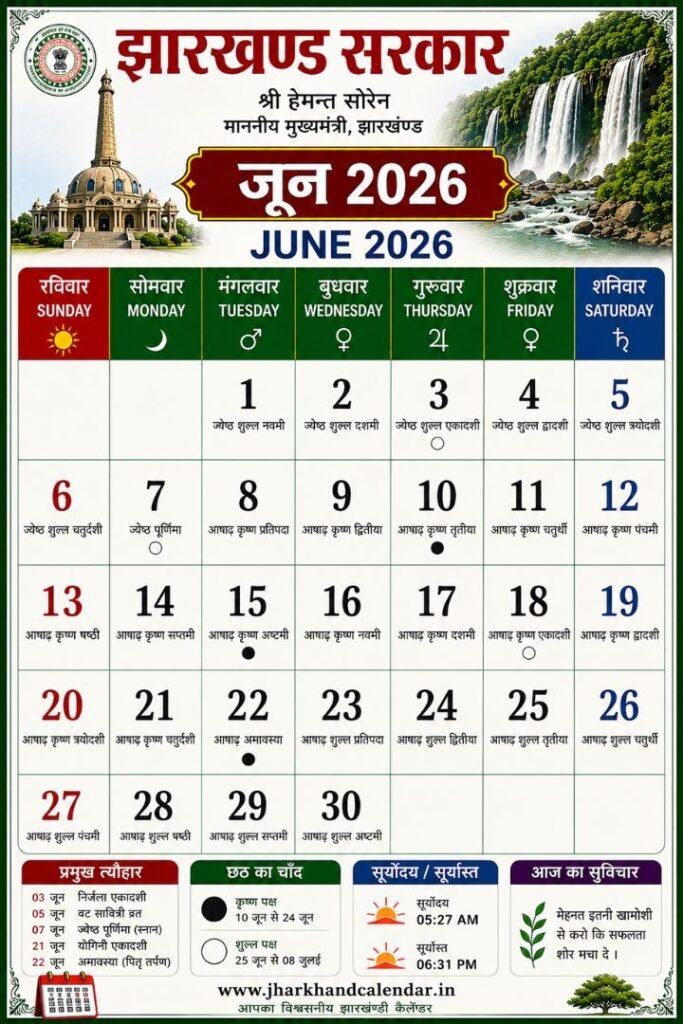
Download the Jharkhand Calendar 2026 June PDF
For offline access, you can download the complete Jharkhand Calendar for June 2026 in PDF format. It’s a handy, printable version you can pin on your wall, put up on an office notice board, or save on your phone for quick reference anytime.
Detailed Look at June 2026 Festivals and Holidays in Jharkhand
Sankashti Chaturthi – 3 June (Wednesday)
The month begins with the regular monthly observance dedicated to Lord Ganesha. Devotees fast through the day and break their fast after sighting the moon in the evening, a ritual followed faithfully across many Jharkhand households every month.
Parama Ekadashi – 11 June (Thursday)
Parama Ekadashi falls in the Krishna Paksha of the Ashadha month (as per the Adhik Maas-adjusted calendar this year) and is considered highly meritorious. Devotees observe a fast believing it grants freedom from sins and brings spiritual growth.
Pradosh Vrat (Krishna) – 12 June (Friday)
Pradosh Vrat is a twice-monthly fasting ritual dedicated to Lord Shiva, observed on the Trayodashi (13th day) of each lunar fortnight. Devotees pray for good health, prosperity, and protection from obstacles on this day.
Jyeshtha Amavasya / Mithuna Sankranti – 14 June (Sunday)
This no-moon day falls in the Jyeshtha month and is traditionally significant for ancestral worship, fasting, and charitable acts. The same day also marks Mithuna Sankranti, the sun’s transition into the Gemini zodiac sign as per the solar calendar, adding another layer of astrological importance.
International Yoga Day / Father’s Day – 21 June (Sunday)
International Yoga Day is observed globally on 21 June every year, following its adoption by the United Nations to promote the physical and mental benefits of yoga. Across Jharkhand, government institutions, schools, and yoga centers organize mass yoga sessions and awareness camps. This year, the date also coincides with Father’s Day, giving families a reason to combine wellness activities with time spent celebrating fathers and father figures.
Nirjala Ekadashi – 25 June (Thursday)
Considered the most challenging of all the Ekadashi fasts, Nirjala Ekadashi requires devotees to abstain from both food and water for the entire day. It’s believed that observing this single fast carries the combined merit of all other Ekadashi fasts throughout the year. Many devotees across Jharkhand undertake this vrat with great discipline, making it one of the most spiritually significant days of the month.
Muharram – 26 June (Friday)
Muharram marks the beginning of the Islamic New Year and is observed with particular solemnity on Ashura, the tenth day, commemorating the martyrdom of Imam Hussain at the Battle of Karbala. Processions, known as Tazia, are taken out in many parts of Jharkhand, and the day is observed as a gazetted holiday across the state. As with other Islamic dates, the exact day may shift slightly depending on moon sighting.
Pradosh Vrat (Shukla) – 27 June (Saturday)
The second Pradosh Vrat of the month falls on this date, observed in the Shukla Paksha this time, with devotees again fasting and praying to Lord Shiva for wellbeing and the removal of obstacles.
Jyeshtha Purnima (Vat Purnima Vrat) – 29 June (Monday)
Jyeshtha Purnima, the full moon day of the Jyeshtha month, is also observed as Vat Purnima Vrat in many households, where married women pray for the wellbeing and long life of their husbands around a banyan (vat) tree — a ritual closely related to Vat Savitri Vrat observed earlier in the year.
Hul Diwas – 30 June (Tuesday)
The month closes with one of the most historically significant dates on Jharkhand’s entire calendar. Hul Diwas commemorates the Santhal Hul of 1855, when Sidho and Kanhu Murmu led thousands of Santhal tribespeople in an uprising against oppressive colonial policies and exploitative landlords. It stands as one of the earliest large-scale tribal rebellions in Indian history and is a powerful symbol of resistance and identity for the Santhal community. Observed as an executive holiday, the day is marked with tributes, processions, and cultural programs, particularly in the Santhal Pargana region, honoring the memory of those who took part in the movement.
Bank Holidays in June 2026
As per the RBI’s holiday schedule, banks in Jharkhand remain closed on all Sundays and on the second and fourth Saturdays of every month. In June 2026, this translates to:
- All Sundays – 7th, 14th, 21st, and 28th June
- 13 June (Saturday) – 2nd Saturday Bank Holiday
- 27 June (Saturday) – 4th Saturday Bank Holiday
Banks will also remain closed on Muharram (26 June), a gazetted holiday. Since this falls just a day before the 4th Saturday bank holiday, it effectively creates a short banking break toward the end of the month, so plan any urgent transactions accordingly.
How to Use This Calendar Effectively
- Government employees should note that Muharram is the only gazetted holiday this month, while Hul Diwas is observed as an executive holiday, which may apply differently depending on department and region.
- Bank customers should be mindful of the back-to-back closures around 26 and 27 June.
- Students and job seekers can plan around International Yoga Day, when many schools organize special sessions or half-day schedules.
- Devotees observing Nirjala Ekadashi should prepare in advance, given the strictness of this particular fast compared to other Ekadashi observances.
- History enthusiasts and residents of the Santhal Pargana region will find Hul Diwas on 30 June to be a meaningful day to learn about and participate in commemorations of this important chapter in Jharkhand’s history.
The Significance of Hul Diwas for Jharkhand
Hul Diwas deserves special mention because it isn’t just a regional holiday — it’s a cornerstone of Jharkhand’s identity. The Santhal Hul of 1855 predates many of the more widely known freedom movements in Indian history and reflects the long-standing spirit of resistance among the state’s tribal communities. For anyone looking to understand Jharkhand beyond its festivals and holidays, Hul Diwas offers a meaningful entry point into the region’s rich and often under-told history.
Jharkhand Calendar vs National Calendar – What’s Different?
While Muharram and International Yoga Day are recognized nationally and globally, Hul Diwas is a date you won’t find on most generic Indian calendars, despite its deep historical importance to Jharkhand. This is precisely why a localized calendar like this one matters — it brings visibility to dates that hold genuine regional significance but often go unnoticed outside the state.
Frequently Asked Questions
Q1. What is Hul Diwas, and why is it important in Jharkhand? Hul Diwas, observed on 30 June, commemorates the Santhal Hul of 1855, a major tribal uprising against colonial rule led by Sidho and Kanhu Murmu. It’s an executive holiday and a significant date for Jharkhand’s Santhal community.
Q2. How many gazetted holidays are there in Jharkhand in June 2026? June 2026 has one gazetted holiday: Muharram, observed on 26 June.
Q3. What makes Nirjala Ekadashi different from other Ekadashi fasts? Nirjala Ekadashi requires devotees to abstain from both food and water for the entire day, making it the most rigorous of all Ekadashi observances during the year.
Q4. How many bank holidays are there in June 2026? Apart from Sundays, banks remain closed on the 2nd Saturday (13 June), the 4th Saturday (27 June), and Muharram (26 June).
Q5. Is International Yoga Day a public holiday in Jharkhand? No, International Yoga Day (21 June) is an observance rather than a public holiday, though many schools and government institutions organize special yoga sessions and events on this day.
Q6. Who led the Santhal Hul of 1855? The uprising was led by brothers Sidho and Kanhu Murmu, along with other Santhal leaders, against exploitative colonial and landlord practices in the region.