August 2026 gives Jharkhand 2 gazetted holidays (Independence Day and Milad-un-Nabi), 1 executive holiday (Raksha Bandhan), and 2 dedicated Saturday bank holidays — all layered on top of one of the busiest devotional stretches of the year, since the entire month runs alongside the sacred Shravan lunar month. Below is the complete day-by-day breakdown, cross-checked against current Panchang and holiday-authority sources, along with a reference table and answers to the questions people actually search for.
Why This Particular August Stands Out
Some months repeat the same handful of observances every year without much variation. August in Jharkhand isn’t one of them. Within the same 31 days, the state marks a UN-recognized day for its tribal communities, India’s biggest patriotic holiday, and the emotional high point of the sibling calendar — Raksha Bandhan — while the entire month runs alongside Shravan, the lunar month considered most sacred to Lord Shiva. For a state where tribal identity, national history, and religious practice all carry genuine weight, August isn’t just another entry on the calendar. It’s the one month where all three overlap.
That overlap also raises real scheduling questions. Will banks be open on the 15th? Is Raksha Bandhan paid leave if you work in the private sector? Does the Milad-un-Nabi date ever move? This guide works through each of those using verified dates for 2026, rather than a template copied forward from a previous year.
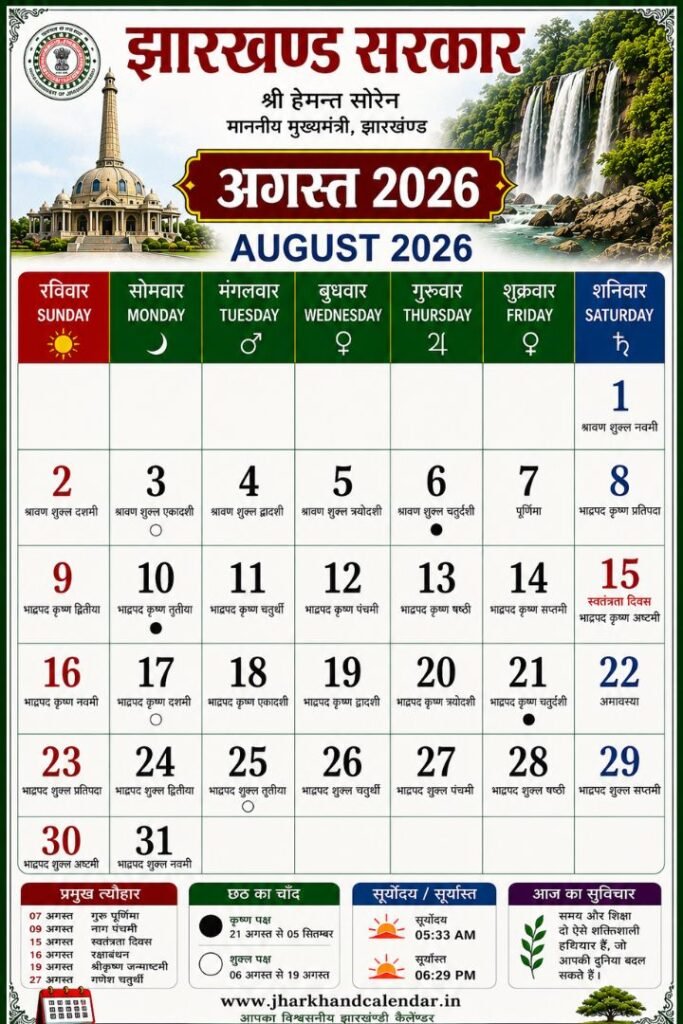
August 2026 at a Glance
| Date | Day | What’s Observed | Category | Closure Status |
|---|---|---|---|---|
| 8 Aug | Saturday | Second Saturday | Bank holiday | Banks closed |
| 9 Aug | Sunday | World Tribal Day (Vishva Adivasi Diwas) + Aja Ekadashi | Observance / Vrat | Sunday closure |
| 11 Aug | Tuesday | Pradosh Vrat (Krishna Paksha) | Vrat / Panchang | Working day |
| 12 Aug | Wednesday | Shravan Amavasya | Vrat / Panchang | Working day |
| 15 Aug | Saturday | Independence Day + Hariyali Teej | Gazetted holiday | All closed |
| 17 Aug | Monday | Nag Panchami + Simha Sankranti | Religious / Panchang | Working day |
| 20 Aug | Thursday | Tulsidas Jayanti | Religious observance | Working day |
| 22 Aug | Saturday | Fourth Saturday | Bank holiday | Banks closed |
| 23 Aug | Sunday | Shravana Putrada Ekadashi | Vrat / Panchang | Sunday closure |
| 24 Aug | Monday | Pradosh Vrat (Shukla Paksha) | Vrat / Panchang | Working day |
| 26 Aug | Wednesday | Milad-un-Nabi* | Gazetted holiday | All closed |
| 28 Aug | Friday | Raksha Bandhan + Shravan Purnima / Gayatri Jayanti | Executive holiday | Govt. closed; private sector varies |
| 29 Aug | Saturday | Bhadrapada begins | Panchang | Working day |
*Milad-un-Nabi is confirmed by moon sighting, so the exact date can shift by a day — explained further down.
Making Sense of Jharkhand’s Holiday Categories
One thing trips people up every year: not every date on this list closes the same doors. Jharkhand, like the rest of India, runs on four overlapping holiday systems, and knowing which one applies tells you exactly what to expect.
- Gazetted holidays are notified for near-universal observance — government offices, courts, schools, and most banks shut down. Independence Day and Milad-un-Nabi fall here this month.
- Executive (or restricted) holidays are declared by the state but applied more selectively. Government departments typically observe them, but whether a private employer treats the day as paid leave comes down to that employer’s own policy. Raksha Bandhan sits in this category in 2026.
- Bank holidays follow the Reserve Bank of India’s own schedule under the Negotiable Instruments Act: every Sunday, plus the second and fourth Saturday of each month, regardless of what else is being celebrated.
- Religious observances and Panchang dates — Ekadashi, Pradosh Vrat, Amavasya, Purnima — don’t close any institution officially. They matter for personal fasting, temple visits, and rituals, not for office attendance.
Knowing this distinction is the difference between planning a long weekend correctly and turning up to a bank that’s actually open.
The Two Gazetted Holidays This Month
Independence Day — Saturday, 15 August
India’s Independence Day this year falls on a Saturday, which happens to be the third Saturday of the month — not one of the two Saturdays banks are automatically closed on. Flag-hoisting ceremonies, cultural programs, and patriotic events take place across Ranchi, Jamshedpur, Dhanbad, and every district headquarters, with schools, government offices, and banks all closed for the day regardless.
Milad-un-Nabi — Wednesday, 26 August (pending moon sighting)
This gazetted holiday honors the Prophet Muhammad’s birth, marked through mosque prayers, community processions, and gatherings that reflect on his teachings. Because the Islamic calendar runs on lunar sightings rather than a fixed astronomical formula, the state’s eventual notification sometimes lands a day off from what early almanac projections suggest for Rabi’ al-Awwal. Treat 26 August as the working estimate and check the official notification as the date approaches.
World Tribal Day: The One Date That’s Distinctly Jharkhand’s
Sunday, 9 August
Nearly every Indian state’s calendar carries Independence Day and Raksha Bandhan. Far fewer carry World Tribal Day with the weight Jharkhand gives it — and that’s precisely why a state-specific calendar earns its place over a generic national one. The date is officially recognized by the United Nations as the International Day of the World’s Indigenous Peoples, and with one of the largest tribal populations of any Indian state, Jharkhand treats it as considerably more than an entry on an international observance list. Cultural departments, universities, and community organizations typically mark it with Santhal, Munda, Oraon, and Ho dance performances, seminars on land and forest rights, and exhibitions of indigenous art and craft. Falling on a Sunday in 2026, it’s set up well for evening cultural programs drawing bigger public crowds than a weekday observance usually would.
Shravan’s Vrat Calendar: The Month’s Busiest Devotional Stretch
Devotees who follow the Panchang will find August 2026 unusually dense with fasting and worship days, since the tail end of Shravan runs through almost the entire month. Here’s the sequence grouped by type, rather than scattered date by date.
The two Ekadashis
Aja Ekadashi (9 August) falls in Krishna Paksha and is observed with a fast to Lord Vishnu, traditionally believed to lighten the burden of past mistakes. Shravana Putrada Ekadashi (23 August) falls in Shukla Paksha — “Putrada” translates loosely to “child-granting” — and couples hoping to start or grow a family often direct this particular fast toward that intention.
The two Pradosh Vrats
Pradosh Vrat recurs twice a month on the Trayodashi (13th lunar day) and is dedicated to Lord Shiva. Both instances this month — 11 August (Krishna Paksha) and 24 August (Shukla Paksha) — carry extra significance because they fall inside Shravan itself, the month most closely tied to Shiva worship.
Amavasya and Purnima — the month’s bookends
Shravan Amavasya (12 August) is a no-moon day traditionally used for ancestral rites and temple visits. Sixteen days later, Shravan Purnima (28 August) closes out the month on its full-moon day, doing double duty this year as Raksha Bandhan and Gayatri Jayanti (more on that below).
Nag Panchami and Simha Sankranti (17 August)
Nag Panchami honors serpent deities with milk offerings at snake idols and anthills, rooted in the belief that serpents guard fertility and offer protection. The same date marks Simha Sankranti, the sun’s solar transition into Leo — an entirely separate calendrical event that happens to land on the same day this year.
Tulsidas Jayanti (20 August)
This one breaks from the vrat cycle entirely — it’s the birth anniversary of Goswami Tulsidas, best remembered for writing the Ramcharitmanas, and devotees mark it through recitations and temple visits instead of a fast.
Raksha Bandhan and Shravan Purnima: The Month’s Emotional Centerpiece
Friday, 28 August
Raksha Bandhan lands on Shravan Purnima this year, with the familiar rakhi-tying ritual between siblings falling on a Friday — convenient timing that turns the day into a natural long weekend for families gathering to celebrate. Because it’s classified as an executive rather than a gazetted holiday, government offices in Jharkhand typically observe it, but private-sector employees should confirm with HR rather than assume, since observance isn’t guaranteed the way it is for Independence Day.
The same full moon carries a second layer of meaning as Gayatri Jayanti, a day set aside for Goddess Gayatri and the mantra named after her, which tradition credits as the source verse behind the Vedas. It tends to stay quieter than the Raksha Bandhan celebrations happening alongside it, observed mainly through home fire rituals and private recitation rather than public festivity.
Hariyali Teej: When a Monsoon Festival Meets a National Holiday
Saturday, 15 August
Hariyali Teej celebrates the reunion of Shiva and Parvati, and its name nods to the monsoon greenery that arrives around the same time. The observance itself is simple: a day-long fast, green clothing, and prayers for a husband’s long life, kept mostly by women across the state. What makes 2026 unusual is that this lands on Independence Day, simply because the fixed Gregorian date and the moving lunar tithi happen to coincide this particular year — a one-off overlap, not a pattern that repeats.
Bank Holidays in Jharkhand, August 2026
Under the Reserve Bank of India’s standard schedule, Jharkhand’s banks close for:
- Every Sunday — 2, 9, 16, 23, and 30 August
- Second Saturday — 8 August
- Fourth Saturday — 22 August
- Both gazetted holidays — Independence Day (15 August) and Milad-un-Nabi (26 August)
Add it up, and banks across the state are shut on nine separate days this month. One nuance worth flagging: Independence Day falls on the third Saturday in 2026, not the second or fourth, so under the pure Saturday rule banks would normally have been open that day. They’re closed anyway, but only because it’s a gazetted holiday — not because of the Saturday pattern. It’s a small distinction, but it’s exactly the kind of detail that trips people up when they assume every August Saturday behaves the same way.
Planning Around This Month: Quick Guidance by Who You Are
- Government employees: two gazetted holidays (Independence Day, Milad-un-Nabi) plus one executive holiday (Raksha Bandhan). Check your department’s own circular if you’re unsure whether the executive holiday applies to your office.
- Bank customers: batch branch visits and cheque clearances around the 2nd, 8th, 9th, 15th, 16th, 22nd, 23rd, 26th, and 30th — the nine days a branch could plausibly be shut.
- Private-sector employees: only Independence Day is guaranteed off by law. Raksha Bandhan depends entirely on your employer’s own holiday list, so it’s worth checking now rather than assuming.
- Families celebrating Raksha Bandhan: 28 August landing on a Friday is about as convenient as this festival gets — it sets up a natural three-day stretch without needing to request extra leave.
- Anyone organizing World Tribal Day events: 9 August falling on a Sunday generally means better turnout for public cultural programs than a weekday slot would allow.
- Devotees following the Panchang: this is genuinely one of the busiest fasting months of the year — two Ekadashis, two Pradosh Vrats, one Amavasya, one Purnima, and Nag Panchami, all inside three weeks. Planning meals and temple visits ahead of time helps.
How This Differs From a Generic National Calendar
A pan-India calendar will list Independence Day, Raksha Bandhan, and Milad-un-Nabi without hesitation — those are recognized nationwide. What it won’t explain is why World Tribal Day carries more weight in Jharkhand than in states with smaller tribal populations, or how Hariyali Teej and Nag Panchami fold into distinctly local timing and custom in this part of eastern India. That local layer is the entire reason a state-specific calendar is worth more than a generic template: it explains not just what’s being observed, but why it matters here specifically.
Frequently Asked Questions
Q1: How many gazetted holidays does Jharkhand have in August 2026? Two: Independence Day (15 August) and Milad-un-Nabi (26 August, pending final moon-sighting confirmation).
Q2: Is Raksha Bandhan a gazetted holiday in Jharkhand? No. It’s classified as an executive holiday, so government offices generally observe it while private organizations set their own policy.
Q3: Why do Independence Day and Hariyali Teej fall on the same date in 2026? It’s a coincidence of two different calendar systems overlapping. Independence Day is fixed to the Gregorian calendar every 15 August; Hariyali Teej follows the lunar Shravan month and only lands on 15 August this particular year.
Q4: How many bank holidays does Jharkhand have in August 2026, beyond Sundays? Four additional closures: the second Saturday (8 August), the fourth Saturday (22 August), and the two gazetted holidays (15 and 26 August).
Q5: Can the Milad-un-Nabi date change? Yes. Like all Islamic-calendar dates, it’s confirmed by the sighting of the crescent moon, so the official date can move a day earlier or later than almanac projections. Check the state’s official notification as the date nears.